Complexity → Clarity : Zoox
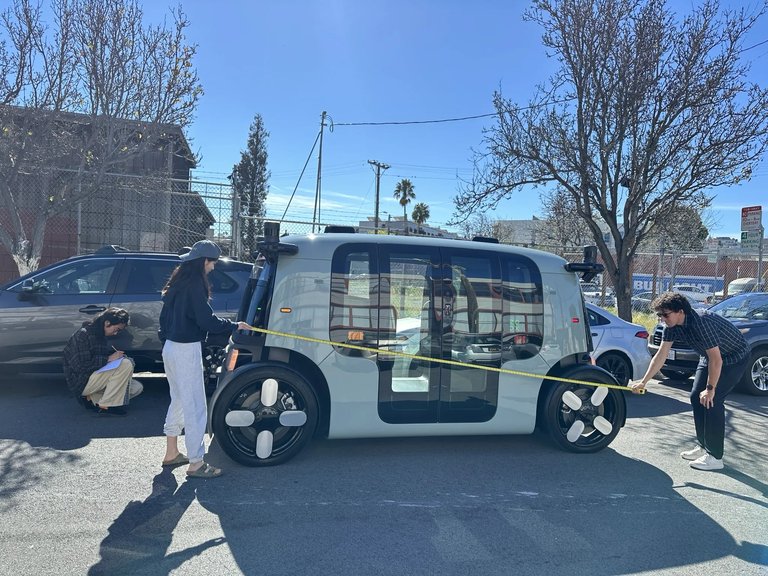
This spring, CCA partnered with Zoox and Autodesk to explore the future of autonomous mobility.

Photo by Shujan Bertrand.
The California College of the Arts (CCA) Industrial Design program recently partnered with Zoox and Autodesk on an interdisciplinary circular design initiative. The collaboration was started by Shujan Bertrand, Chair of Industrial Design, who spent two years architecting and developing the program alongside core industry partners.
What followed was a collaborative Zoox + Autodesk Design Challenge spanning four Bay Area schools: California College of the Arts, Academy of Art University, San José State University, and Diablo Valley College. The partnership began with private tours and research at Zoox's headquarters, culminating in a final concept showcase hosted at Autodesk HQ in San Francisco.
"This kind of partnership shows students how design practice applies beyond the classroom," says Bertrand. "Companies are looking for designers who can think past the obvious, show innovation through storytelling and rendering, and understand what it means to design in a city where so much is being prototyped and launched. That kind of relevant, real-world experience stays with students."
As part of this, Ian Coats MacColl, professor of Industrial Design, led the CCA Investigative Studio. There, students spent the semester exploring urban logistics, social behavior, and passenger experiences. Read his story below on how they turned complex research into clear, future-focused designs.
This spring, CCA partnered with Zoox and Autodesk to explore the future of autonomous mobility, and I had the opportunity to lead the Investigative Studio.
Rather than focusing purely on technology, our studio asked a different question: What new human experiences become possible when the driver disappears?
Sixteen students conducted deep research throughout San Francisco, studying not only autonomous vehicles, but also biking, walking, camping, public transit, urban logistics, and social behavior. The research generated a tremendous amount of information, observations, contradictions, and insights — so much that it was initially difficult to fully digest.
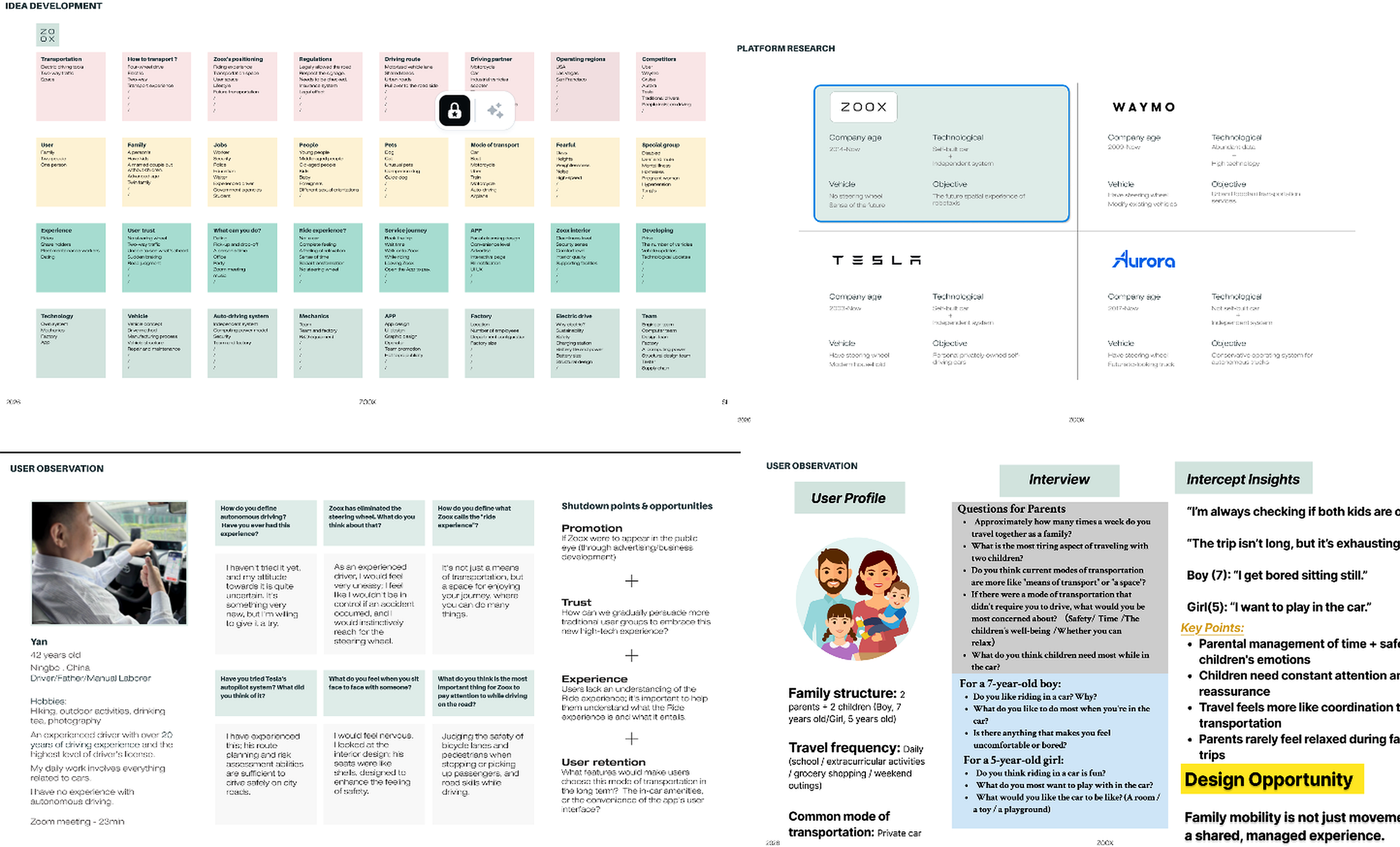
Research often creates complexity before clarity emerges. Early-stage synthesis work by project team members Klay Duanmu, Rey Gu, Sam Liao, and George Wang.
But this is often where design begins.
Through mapping, synthesis, iteration, and countless discussions — both internally and with outside reviewers — the complexity gradually began to resolve into clearer patterns and opportunities. Over time, four distinct areas emerged: Family/Micro Weekday/Weekend.

Project Team: Letizia Lee, Sam Li, Sylvan Hartshorn-Bunis, Tongzai Wang.
The resulting concepts were remarkably diverse.
One team designed an autonomous vehicle for teenagers too young to drive — balancing independence for kids with peace of mind for parents.
Another imagined “car camping without the car,” where an autonomous vehicle drops families and gear at campsites, then departs and returns later for pickup.
A micro-mobility team explored bike-lane-scale transportation for dense urban living, creating an open-air vehicle optimized for local loops, climbing gear, groceries, and flexibility.
Another focused on mobility, dignity, and cultural nuance for an elderly shopper navigating San Francisco’s Chinatown markets.

Top left: Project by Klay Duanmu, Rey Gu, Sam Liao, George Wang
Top right: Project by Letizia Lee, Sam Li, Sylvan Hartshorn-Bunis, Tongzai Wang
Bottom left: Project by Thania Requena-Palencia, Yao Wang, Zack Zhang, Jiajun Deng
Bottom right: Project by Ronan Tang, Karsten Choy, Gloria He, Jimmy Huang
What emerged was not simply vehicle design, but a broader exploration of how autonomy may reshape behavior, infrastructure, and human interaction. The most interesting discoveries were often not technological — they were human.
In other words: complexity → clarity.

Team presentations at Autodesk in San Francisco.
— Ian Coats MacColl, professor of Industrial Design