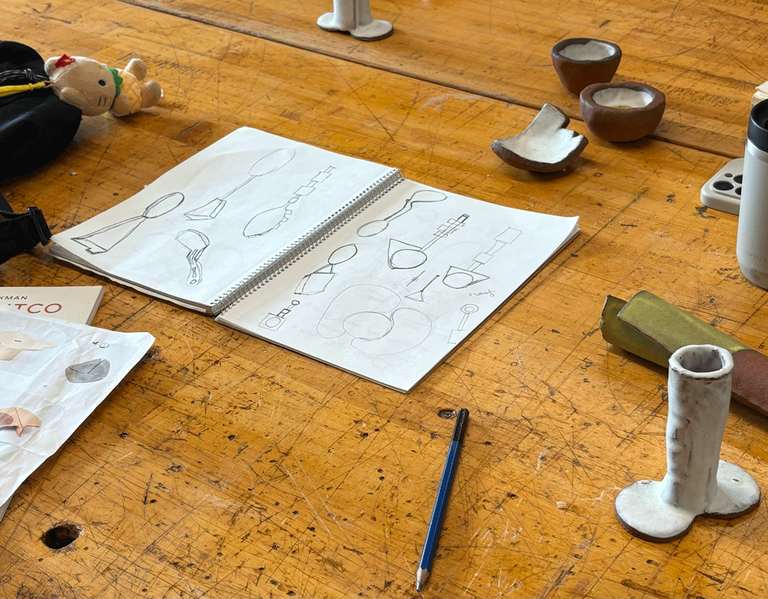
“Oh, There’s More!”
Inspired by celebrated sculptor JB Blunk and a generative prompt, the Atelier: Limited Editions course generates a remarkable and expansive body of work.
CCA once again participated in the FOG Design + Art Fair January 21–25 and San Francisco Art Week January 17–25. At the entry to the fair, visitors encountered FOG MRKT, a curated installation and retail space showcasing local artists and designers, including works from the students in the Atelier program at CCA, as part of the Wattis Institute for Contemporary Arts selections.

Brian Harte instructing Biray Ozdol (MFA Design 2026) on the CNC Router. Photo by Russell Baldon.
Atelier is a wood and furniture-focused studio annual course taught by visiting artists in residence through the Wornick Distinguished Visiting Professor program. The residency provides students opportunities to learn from individuals often outside academia, and is part of CCA’s long history of community building and mentorship by active leaders in emerging and established models of craft and design.
In the past, Atelier has been part of the Furniture program at CCA but, as we evolve our college and curriculum, we are building more pathways for students to explore across disciplines and materials, to build a contemporary practice founded in a wide range of skills, experiences, and critical vocabularies. The fall 2025 course Atelier: Limited Editions was a great example of this curricular direction. Cross listed under several programs, 25 students from across the college, both bachelor’s and and master's candidates, came together to work with Wornick Distinguished Visiting Professor Mariah Nielson (MArch Architecture 2005), and Furniture Professors Katherine Lam and Russell Baldon. Students worked in wood, metal, ceramics, and paper in response to the prompt of producing tabletop limited editions inspired by the work of JB Blunk, Nielson’s father.
Nielson, a curator, design historian, writer, and Director of the JB Blunk Estate, was “an important part of the magic,” says Lam. “The Wornick visiting artist program has a long legacy of expanding traditional academic expectations. We shaped this course to balance structure and freedom, allowing students to work at their own pace and also learn from one another in shared making spaces. This allowed for the multitude of courageous, considered ideas to emerge.” Baldon adds that, "Everyone involved came together to create a truly magical studio experience. The hard work, generosity, and celebration inherent in this kind of craft practice soothes my soul.” All semester there was a captivating and vibrant energy in the furniture bench room: the happy chaos of chainsaws, metal finishing, carving with Manpa tools, and sketching, gracefully managed by master craftsman and furniture studio manager Brian Harte. Harte, Lam, and Baldon were in the studio well beyond regular hours, supporting the prolific output of the cohort.
“Everyone involved came together to create a truly magical studio experience. The hard work, generosity, and celebration inherent in this kind of craft practice soothes my soul.”
associate professor of Furniture
Keeley Rideout (MFA Design 2026) echoed the chainsaw marks in her delicate redwood boxes with the texture on silver and bronze rings, whose smooth bowls are inspired by a bathroom sink carved by Blunk. “It was wonderful to work with Mariah, she brought such a wide range of references and perspectives, and with Kathy and Russell, whose push was always there, but so perfectly gentle,” says Rideout.
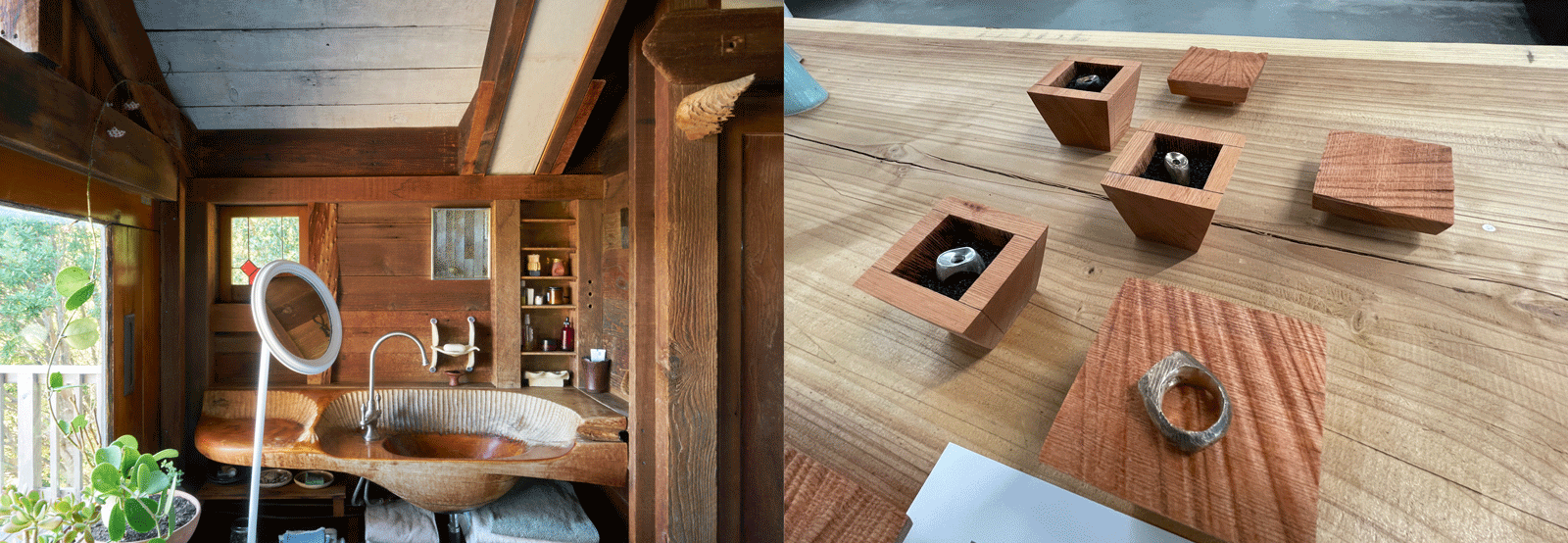
Left: Sink in the Blunk House in Inverness, California. Photo by Leslie Williamson. Courtesy of the JB Blunk Estate. Right: Keeley Rideout, Rings and Boxes. Photo by Russell Baldon.
“It was crazy to walk in and realize Mariah was teaching this class. JB Blunk is one of the reasons I got into working with wood,” says Shuta Kobayashi (MFA Design 2026). Kobayashi began his Limited Edition wanting to honor both Blunk and Noguchi. Building off Blunk’s iconic arch, Kobayashi describes that the edition has been a reference to Blunk, “but has also become my own. I’ve wrapped my life around this guy,” he says pointing to the evolving form of bull-arch-clothespin organic boxes, sculptures, and lamps in the Atelier final review, “letting each iteration grow into the next.”
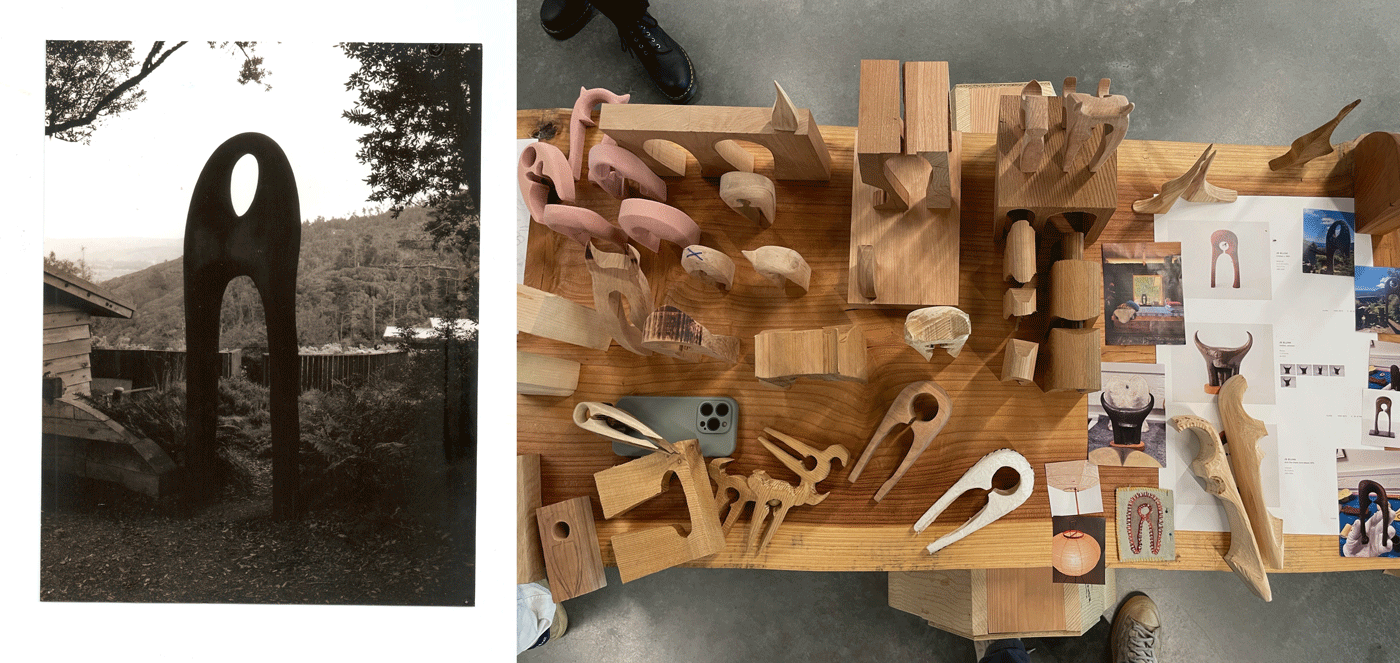
Left: JB Blunk, Entry Arch (Presence), c. 1977. Courtesy of the JB Blunk Estate. Right: Shuta Kobayashi, Limited Edition. Photo by Russell Baldon.
Spencer Jones (Individualized Studies 2027) was inspired by Blunk’s use of found materials, and the intimate, casual spirit of employees squatting on crates during smoke breaks. Jones began by making 27 of what he called sketches– quick, found material stools. “I’d drive around every night after work pulling things off the street,” he says. ”I enjoyed making them without a plan, and then translating the fragile sketch into these chairs that by their material and structure can’t feel fragile.” He finished with three steel chairs that reference the quick sketches but are solid, comfortable seats.
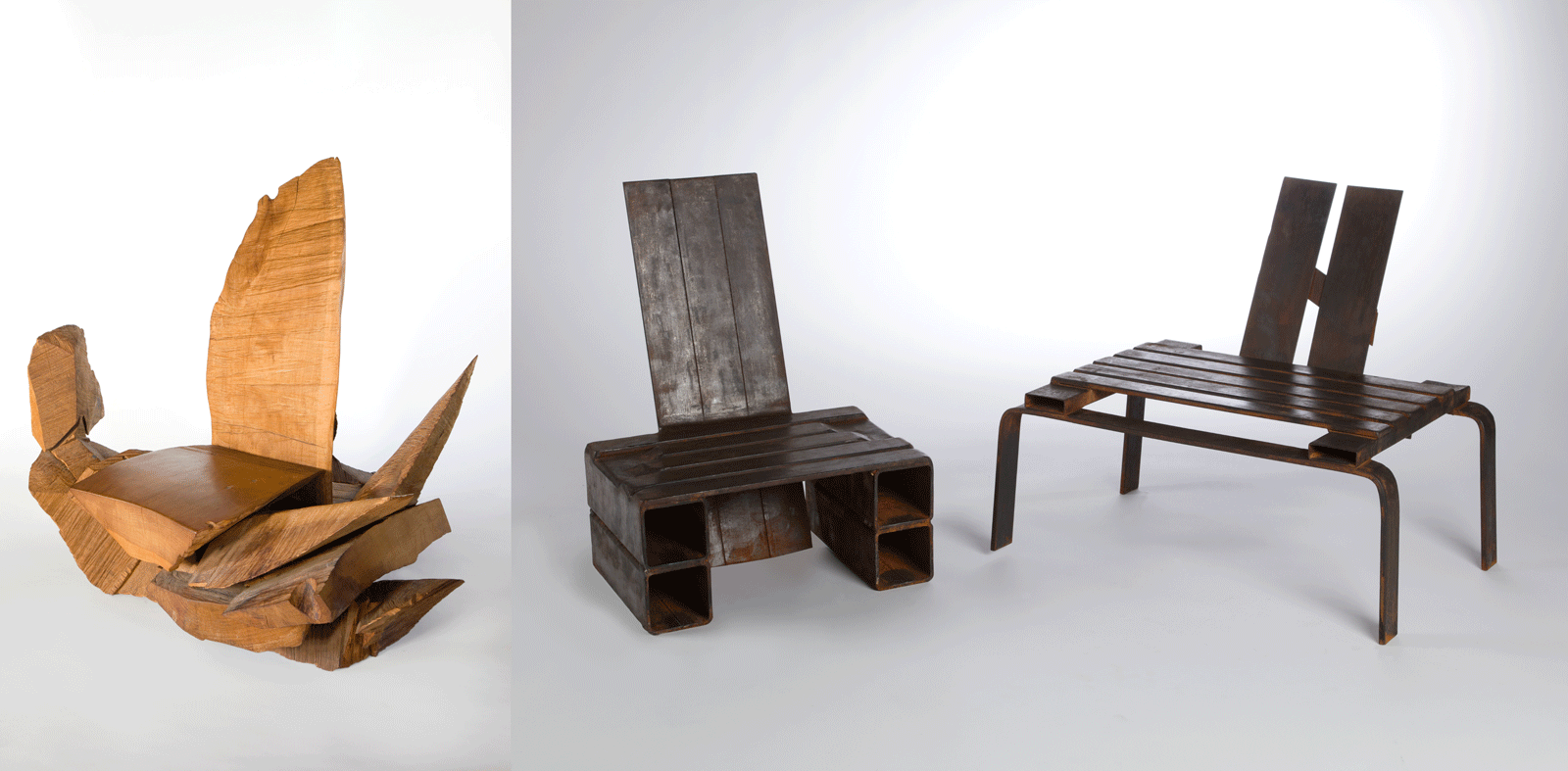
Left: JB Blunk, Scrap Chair, 1968. Courtesy Museum of Arts and Design, New York. Right: Jones, S. Chairs, 2025. Photo by Mark Seer.

Biray Ozdol and Kate Greenberg talking by Ozdol’s work. Photo by Saraleah Fordyce.
I had the immense pleasure of seeing these works and many others, walking the Atelier final review with Designer Kate Greenberg (BFA Furniture 2020). Greenberg, with designer and collaborator Kelley Perumbeti, produces the Works In Progress furniture and sculpture exhibition series. Works in Progress is preparing their fourth exhibition and will also participate in FOG this year. Kate reflected that “If you set up some constraint — like responding to a specific work or artist ethos — then this can be a surprisingly freeing way to work. These artists began with a conversation Blunk was having in his world, with the time and materials there, and are continuing that conversation now in our time.” Nielson, Lam, and Baldon chose to organize the final review as a gallery of conversations rather than a traditional critique. Faculty, students, and invited members of the CCA furniture community walked from table to table to talk with the Atelier students about the work and experience of the class. The format extended the bustling, vibrant, collaborative feeling of the semester.
We saw incredible work that day, from Biray Ozdol’s (MFA Design 2026) live edge sets of lateral nesting trays, to Leslie Podell’s (BFA Furniture 2021) zinc and dyed wood stools, and Badri Valian’s (MFA and VCS 2026) kinetic sculptures that touch on gender, religion, beauty and trauma, to Posy DiPaolo’s (BFA Jewelry Metal Arts 2025) research on self piercing forms that offer resting places for jewelry. Each student we spoke with said a version of, “Oh! There’s more,” encouraging us to see the proliferation of more work that came out of this alchemic joining of teachers, students, materials and inspiration. Nielsen, looking at the inspiring spread of production adds, “I was so impressed by the range of responses the students brought to the brief. Their curiosity and enthusiasm were truly inspiring, and I’m very proud of what each student accomplished.” Enjoy this gallery, and keep an eye out for their incredible work at FOG 2026.
—Saraleah Fordyce