
Three Questions for Sara Raffo
Communication Design Associate Professor Sara Raffo answers three questions about why it’s essential to get out of the studio for experiential learning.

Raffo (right) visiting Birdcall studio with study abroad students in Seoul, South Korea, summer 2025. Photo by Jisu Lee.
Communication Design Associate Professor Sara Raffo has been teaching at California College of the Arts (CCA) since 2014 in graduate and undergraduate graphic design. Her specialty from the beginning was to introduce students to the tools and methods of the practice, helping them to build a solid foundation for further study. Then in summer 2023, Sara led her first study abroad class to Seoul, South Korea, where the group visited design sites, exhibitions, and met with designers in their studios. She returned from the experience energized about the intense and multisensory learning that happens “in the wild.” She wondered how to bring the same rich experiences to students during the regular semester. The answer was “Visiting Designers + Workshops,” a studio class that makes the most of the rich communication design culture just outside of our Hooper gates, and helps students to see the many ways they might be a designer today while linking their passions with their practice.
Here, Raffo answers three questions about why it’s essential to get out of the studio for experiential learning.
1. What do you think are the most important things that young designers have to learn from visiting the studios of practicing designers?
The course was designed for first year students to learn about the breadth of what a communication design practice can be, beyond assumptions or existing models they have encountered so far. We go from students believing communication design is “mostly posters” to a memorable share from alum John Provencher (BFA Graphic Design 2015), telling us he “learned the courage to do anything by studying design at CCA.” This transformation comes through visiting 15–20 designers, from in-house teams at cultural institutions such as the de Young, to scrappy collaboratives such as GRL GRP, and highly secured tech spaces such as Anthropic with Tim Belonax and members of the creative and marketing teams there.
“With each studio visit, we strengthen our powers of curiosity, listening, and reflection—underlying aspects of the course that are critical to education right now.”
associate professor of Communication Design

Exploring design history at the Letterform Archive with founder Rob Saunders, fall 2024. Photo by Sara Raffo.
These students, while they are learning the essential tools and methods of our discipline—precision, anchor points, vector paths, underlying grids, motion graphics, and letter kerning—can simultaneously ask: What is communication design? Who makes it? Why? For whom? How do actual humans bring their past, their culture, their lived experience, and their dreams into their work?
First year communication design students are standing at a boundary. It’s a moment of self-definition. As a teacher, I can feel the urgency of this moment as we listen to practicing designers describe themselves and their work. It’s transformative for students to be able to follow up with their specific questions: Can we see your Illustrator file? Why did you use that typeface? Why that color? I wanted to ask you about the existential crisis you mentioned… I feel like I’m going through something similar…
With each studio visit, we strengthen our powers of curiosity, listening, and reflection—underlying aspects of the course that are critical to education right now. Students are actively creating knowledge and sensing the future as it emerges.
2. What are the benefits of moving outside of the classroom and into the studio or workshop space?

Caitlin Kirkpatrick demonstrates a type lockup to students at Arion Press, fall 2025. Photo by Sara Raffo.
Travel, even local, is an opportunity to get to know each other. It can also start to flatten the power dynamic of the classroom. We are traveling together, we are encountering newness together, we are curious together.
Moving outside the classroom creates new modes of learning beyond lecture, critique, or studio time. Students make friends while sitting together on Muni. One-on-one conversations happen while we walk up a hill together. We look out for each other—opening a door, or noticing who is a block behind. We embrace a certain level of chaos—a missed bus stop becomes a shared legend that connects the group.
“We are traveling together, we are encountering newness together, we are curious together.”
associate professor of Communication Design
When we get to a studio, there is a kind of ambient learning that happens just by being there in a designer’s space. Students can see what’s on someone’s desk, how many desks there are in a room, what is hanging on the walls, what’s on the bookcase, maybe see a project on display that is important but not included in an official presentation. Students can envision what a creative life can be—from considering location, to setting up a physical workspace, to balancing freelance work, to applying for grants, and so many other possibilities.
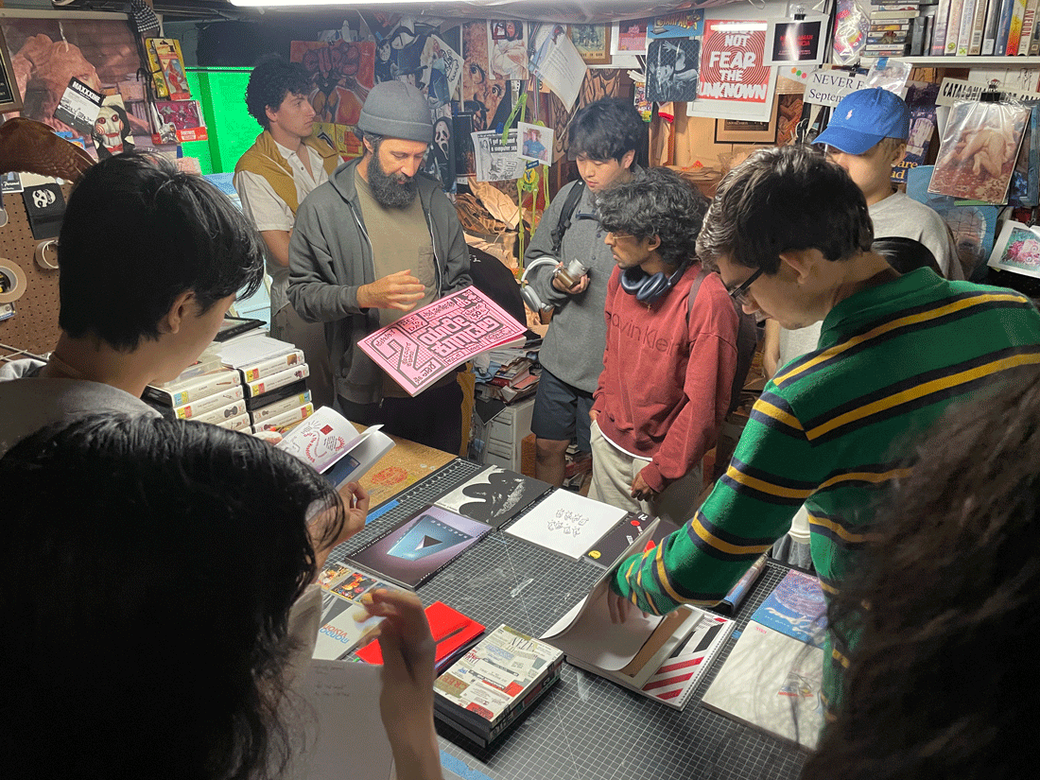
Tour of Colpa Press with Luca Antonucci, fall 2024. Photo by Ian Storm Taylor.
We also visit sites that can only be experienced physically. At Arion Press, we witnessed their 100-year-old monotype and typecasting machines in action. At the Light House for the Blind and Visually Impaired, we had firsthand experience in accessible design by seeing how their workspace is set up for the visually impaired people they serve. At SFMOMA, we learned about the design process and then toured the “Get in the Game” exhibition to see the results at full scale in the galleries.
We visited designers, and designers also visited us at CCA. They led workshops where students actively tried a wide variety of methodologies and modes of making. Carl De Torres condensed his process into a Thinking + Drawing = Design sprint. Helen Shewolfe Tseng invited us to focus on intuition, seeking, and interpreting. I was especially touched by the responsibility and care that practicing designers showed our student designers.
3. Can you share some highlights from Visiting Designers + Workshops?

Everyday Archive workshop with Mintie Jantarakolica, fall 2025. Photo by Sara Raffo.
Regarding cultural representation and expression: Lucille Tenazas, graphic designer and former CCA faculty and Design MFA chair, helped us see how cultural influence can be represented through the impact of language without showing the use of that language. She doesn't use Tagalog or traditional Filipino visual patterns, but her playful approach to typographic composition is a direct result of the multilingual environment in the Philippines where she was raised.
Regarding functions and variability: Ian Storm Taylor, recent MFA Design alum, gave us the profound understanding that constraints are not barriers to creativity, but rather the very framework that gives it form and meaning. The process of beginning with individual, biological observation of floral forms and then channeling our unique interpretations through a shared, mathematical rule-set demonstrated how a well-defined system can amplify, rather than suppress, individual expression.

Visiting the Letterform Archive show Amos Paul Kennedy, Jr.: Citizen Printer, fall 2024. Photo by Ian Storm Taylor.
Regarding candid and honest ethics: Many students were impressed by what Mary Banas, a collaborative creative partner with musicians including Mitski said about the designer’s responsibility when it comes to image manipulation. “It’s the world's smallest feminist movement to leave a woman’s face alone. It’s my message to you as the person clicking the mouse," says Banas.
Regarding immediate and responsive learning: At Pact Studio, a small branding and identity studio located in the Mission, one student was bold enough to ask to see a design file for a project. They opened several files to show how the project was organized and how they moved through their creative process so students could gain perspective on how a practicing designer thinks and develops a specific project.
Regarding learning new tools: Our workshop with Yuin Chien, an independent designer focused on user experience, creative coding, and pottery, offers: “The learning curve is like a plane taking off. It might be rough at first, but then you'll find yourself taking it easier and easier, as you find similarities in a lot of the programs. And you'll eventually be excited about new things.”
—Mara Holt Skov, associate professor of Industrial Design